In short
- Cook building blocks (two bases, two proteins, roasted vegetables, three sauces) and combine them differently each day.
- Prep on Sunday for Monday to Wednesday, and do a short round on Wednesday for Thursday and Friday, because cooked food keeps 3 to 4 days.
- Keep sauces separate until you eat, and add raw greens the morning you pack.
- Includes a shopping list, a five-day grid and USDA storage times.
On this page
Most meal prep advice assumes you're happy eating the same thing five days in a row. Make a big pot of chili on Sunday, split it into five containers, and you're set. That holds up for about two days. By Wednesday the chili is still sitting there, you're sick of it, and you buy a sandwich instead. Now you've paid for lunch twice.
Cooking for one makes it worse. Most recipes are written for four, so "a batch" means a lot of one dish. You either eat it all week or watch the last two portions go bad.
This plan works differently. You cook a few building blocks, keep them in separate containers, and put them together in a new way each day. It's still one shopping trip. There are two short prep sessions instead of one long one, and the five lunches don't match.
Cook parts, not meals
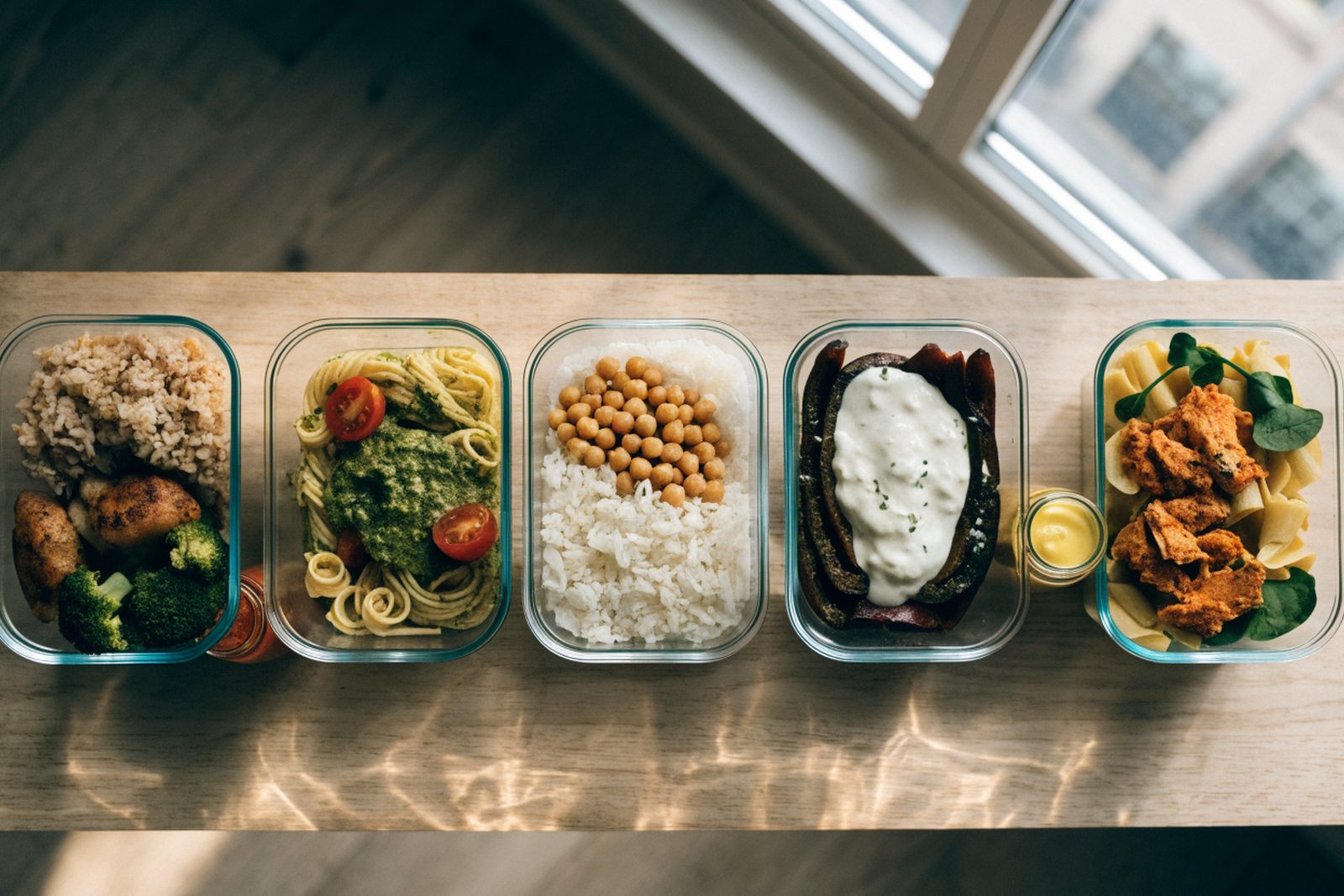
Every lunch here is four things in a container: a base, a protein, a vegetable and a sauce. You cook two bases, two main proteins (plus a can of beans for later in the week), a tray of roasted vegetables, and three sauces.
Two bases times two proteins times three sauces is 12 combinations before you even count the vegetables. You need five.
- Bases: brown rice and a short pasta like penne or fusilli
- Proteins: roasted chicken thighs and a can of chickpeas, with a can of white beans for Friday
- Vegetables: one sheet pan of peppers, zucchini and red onion, plus baby spinach and cherry tomatoes that stay raw
- Sauces: pesto, a lemon-garlic yogurt sauce, and a plain tomato sauce
None of this is fancy, and it isn't meant to be. Plain parts mix well. The sauce does most of the work of making one container taste different from the next, which is why there are three of them and only two bases. If you change anything, keep the sauces far apart in flavor: one herby, one creamy, one tomato.
Why you prep twice instead of once
The USDA says cooked leftovers keep in the fridge for 3 to 4 days. Cook everything on Sunday and Friday's lunch lands on day five, which is past that line.
So the week splits in two. On Sunday you cook for Monday, Tuesday and Wednesday. On Wednesday evening you do a much smaller round for Thursday and Friday.
The chicken gets around the problem a different way. You roast it all on Sunday, keep Monday's portion in the fridge, and freeze Thursday's portion that same day. Move it to the fridge on Wednesday morning and it thaws by the time you pack it. The USDA says leftovers thawed in the fridge are good for another 3 to 4 days, so there's plenty of room.
Shopping list for one week
These are rough starting amounts for one person and five lunches. If you eat bigger lunches, add protein before you add rice.
| Item | Amount | Used on |
|---|---|---|
| Brown rice, dry | About 1 cup | Mon, Wed, Fri |
| Short pasta, dry | About 6 oz | Tue, Thu |
| Boneless chicken thighs | About 3/4 lb (two portions) | Mon, Thu |
| Chickpeas | One 15 oz can | Tue, Wed |
| White beans | One 15 oz can | Fri |
| Bell peppers, zucchini, red onion | 2 peppers, 1 zucchini, 1 onion | Sheet pan, Mon and Wed |
| Baby spinach | 1 small bag | Thu, Fri |
| Cherry tomatoes | 1 pint | Tue, Fri |
| Pesto | 1 small jar, or your own | Tue, Thu |
| Plain Greek yogurt, lemon, garlic | 1 small tub, 1 lemon, a few cloves | Yogurt sauce, Mon and Fri |
| Crushed tomatoes | One small can | Tomato sauce, Wed |
| Olive oil, salt, pepper, dried oregano | From the pantry | Everything |
Sunday: what to do, in order
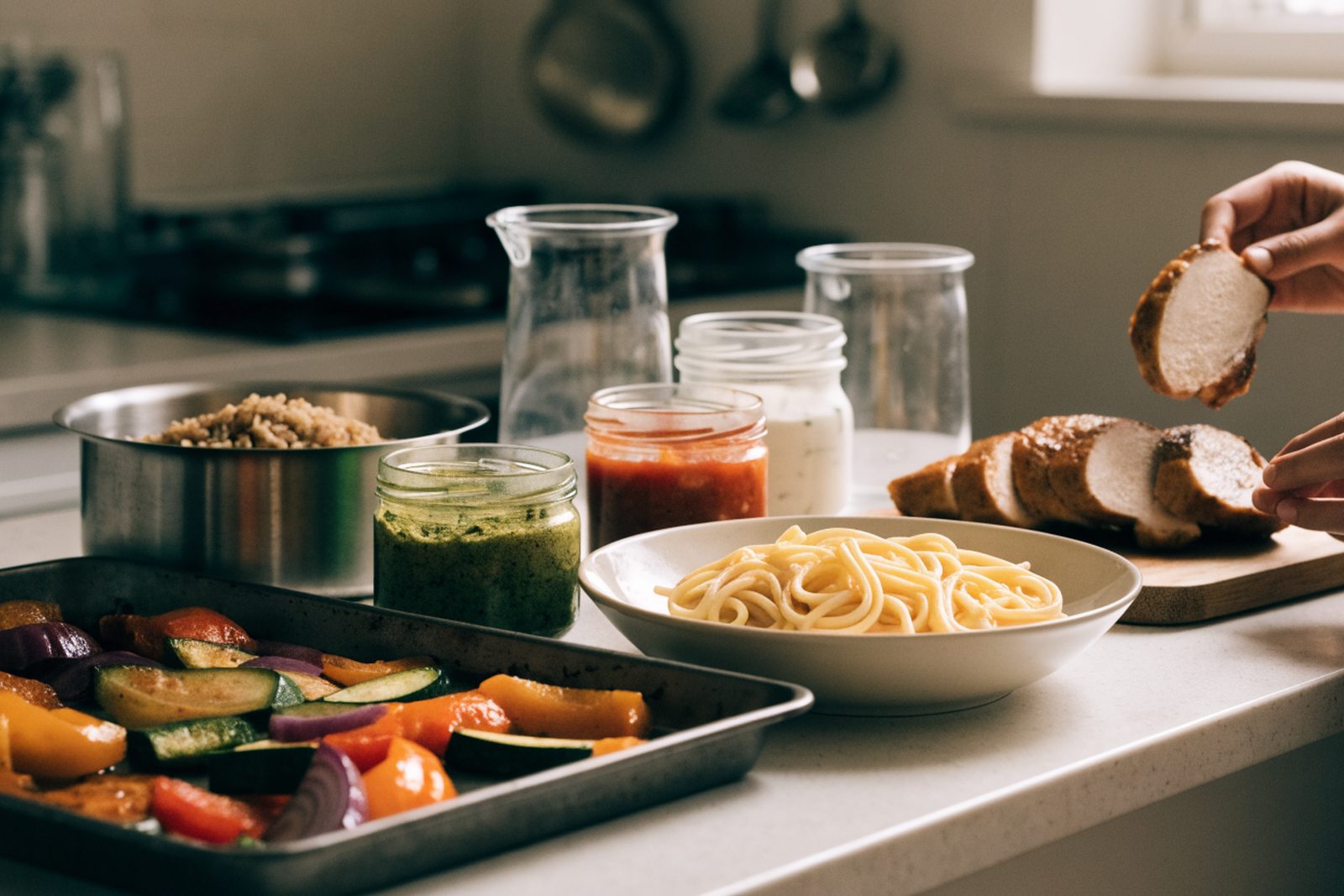
- Start the rice. It cooks on its own for the longest, so it goes first.
- Heat the oven and load two pans. Peppers, zucchini and onion go on one, tossed with oil, salt and oregano. The chicken thighs go on the other. Roast the chicken until a thermometer in the thickest part reads 165°F, the USDA minimum for all poultry.
- While the oven runs, cook the pasta and make two sauces. For the tomato sauce, simmer crushed tomatoes with a little olive oil, garlic, salt and oregano until it thickens. For the yogurt sauce, stir lemon juice, grated garlic and salt into the yogurt.
- Toss the drained pasta with a little olive oil so it doesn't set into one block in the fridge.
- Cool everything fast. Spread food out in shallow containers instead of leaving it in the pot, and get it all into the fridge within 2 hours of cooking.
- Pack Monday to Wednesday, and freeze one chicken portion for Thursday. Sauces go in small jars of their own.
The five-day grid
| Day | Base | Protein | Vegetables | Sauce | Cooked |
|---|---|---|---|---|---|
| Mon | Brown rice | Chicken | Roasted vegetables | Lemon-garlic yogurt | Sunday |
| Tue | Pasta | Chickpeas | Cherry tomatoes | Pesto | Sunday |
| Wed | Brown rice | Chickpeas | Roasted vegetables | Tomato | Sunday |
| Thu | Pasta | Chicken (thawed) | Spinach | Pesto | Wednesday |
| Fri | Brown rice | White beans | Spinach, tomatoes | Lemon-garlic yogurt | Wednesday |
Rice shows up three times and still tastes different each day, because the sauce changes every time. Tuesday and Thursday share pesto, but one is chickpeas with tomatoes and the other is chicken with greens, and they're two days apart.
Wednesday: the short round
This is the part people skip, so it's built to be small. Cook a fresh pot of rice and a fresh batch of pasta, make a new small bowl of yogurt sauce, and open the white beans. Move the frozen chicken to the fridge that morning if you haven't already. Then pack Thursday and Friday.
Wednesday is also the easy place to change course. If you're tired of rice, make pasta twice. If the chicken didn't do it for you, use beans on Thursday too and freeze the chicken for next week.
Storage and reheating
| Situation | USDA guidance |
|---|---|
| Cooked parts in the fridge | 3 to 4 days |
| Cooked parts in the freezer | 3 to 4 months for best quality. Frozen food stays safe longer but dries out and loses flavor |
| Thawing | In the fridge, cold water or the microwave. Fridge-thawed food keeps another 3 to 4 days |
| Reheating | To 165°F, covered so it heats all the way through |
| Left out at room temperature | Throw it away after 2 hours, or 1 hour if it's above 90°F |
| Fridge temperature | 40°F or below |
If your lunch sits in a bag all morning without a fridge, the 2-hour rule applies to it too. An ice pack in the bag is cheap insurance.
Small things that help
- Keep the sauce on the side until you eat. Rice and pasta soak it up and turn heavy if they're dressed days ahead.
- Add the spinach and tomatoes the morning you pack, or right before eating. Greens packed against warm food go limp.
- Cook the pasta a little short of done. It softens again when you reheat it.
- A spoonful of water on cold rice before microwaving keeps it from drying out.
- Write the day on each lid. It sounds fussy, but it saves you from guessing which container is Monday's.
Swaps
- If you don't eat chicken, use a second can of beans, or roast cubed firm tofu on the vegetable pan.
- Quinoa or farro work in place of the rice.
- Short on time Sunday? A store rotisserie chicken counts. Pull the meat, portion it, and freeze half the same day.
- Chimichurri, tahini-lemon or a peanut sauce can stand in for any of the three, as long as the ones you pick don't taste alike.
I'd run it one week as written, then swap out whatever you didn't like. Keep the four-part containers and the two prep days, and change the rest freely.
Pin this plan
It's on our Lunch Prep for One board, so you can find the grid again next Sunday.
Sources: USDA Food Safety and Inspection Service, Leftovers and Food Safety and Safe Minimum Internal Temperature Chart. Amounts are starting points, not tested yields. Adjust them to your appetite.